

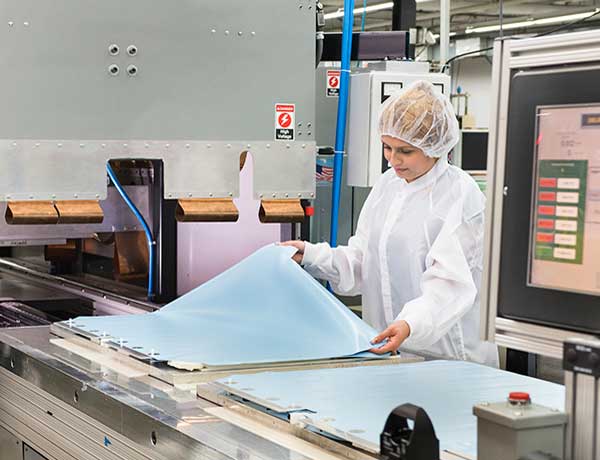
Thermoplastic welding may sound like a simple way to join pieces of plastic: apply heat or energy, materials fuse, done. In the MedTech world, though, it’s anything but simple. For disposable medical devices especially, the integrity of every welded seam is critical to product performance, regulatory compliance, and, ultimately, patient safety. At UFP Technologies, our decades of experience tell us that bond strength, particulate control, and geometry tolerance aren’t just technical details, they are defining factors in whether a device will perform as intended in the field.
Why Thermoplastic Welding Matters in MedTech
Medical devices today are designed to be lighter, more functional, and often single-use. Thermoplastics are invaluable in achieving those goals because they can be formed into complex shapes and chemically welded into strong, hermetic seals without adhesives or fasteners. Compared to sewing, glue, or hot air bonding, thermoplastic welding like RF (radio frequency) welding delivers seals that resist leakage, moisture seepage, and environmental stress – features essential for sterile packaging, fluid handling, and containment of biological matter.
Yet delivering on those promises requires far more than pushing a button on a machine.
Bond Strength: Not All Welds Are Equal
At its core, thermoplastic welding is about joining two materials so they behave as one. In medical devices, this bond must withstand mechanical load, sterilization cycles, and the pressures of handling, transport, and use. Unlike adhesives, which create a separate joining layer, precision welding fuses materials at the molecular level. When done correctly, the joint can deliver strength comparable to the base materials.
Achieving that level of bond strength requires rigorous control of:
- Energy delivery: Sufficient to melt and meld surfaces without degrading material properties.
- Tooling and machine control: Repeatable motion and force profiles ensure uniform welds across batches
- Material consistency: Variations in thickness or formulation can dramatically affect results
Weak or inconsistent bonds are not just quality issues – they can lead to leaks, separation under stress, or failure during sterilization or use.
Particulate Control: Clean Joints for Patient Safety
Particulate generation is a silent but serious concern in medical device manufacturing. Loose particles or contaminants in and around weld zones can compromise sterility, interfere with device function, or trigger foreign-body reactions in patients. While the thermoplastic base materials themselves can be clean, the welding process can introduce tiny flashes, micro-debris, or thermal degradation byproducts if not tightly controlled.
UFP Technologies approaches particulate control through:
- Cleanroom-compatible processes that minimize airborne and surface contamination
- Process optimization that reduces flash and errant melt
- Inspection regimes that catch anomalies before parts move downstream
This is especially important for components that interact with bodily fluids or are part of sterile barrier systems.
Geometry Tolerance: Precision Design + Precision Execution
Weld quality is inseparable from part geometry. Complex shapes, tight tolerances, and thin walls can all complicate the delivery of uniform energy and pressure during welding. Small deviations in parts or joint design can lead to stress concentrations, incomplete fusion, or distortion, any of which can undermine performance.
For disposable devices, which often involve thin films or small components, this precision joining matters more than ever. A micron-level gap here or slight misalignment there can translate to a significant compromise in seal integrity.
Integrated Expertise Drives Predictable Outcomes
Thermoplastic welding in medical devices isn’t a commodity process; it’s a convergence of materials science, precision engineering, and disciplined manufacturing execution. At UFP Technologies, our decades of experience in RF, ultrasonic, impulse, and thermal welding equip our teams to anticipate, control, and optimize the variables that matter most.
From tooling layout and machine parameter control to material selection and ongoing testing (pull, leak, and optical), every aspect of the welding process contributes to a reliable final product that meets performance and regulatory requirements.
Conclusion
Bond strength, particulate control, and geometry tolerance are far more than engineering buzzwords. They are the pillars of reliable, compliant, high-performance thermoplastic welding in medical devices. Manufacturers who recognize and invest in precision joining processes reduce risk, enhance product reliability, and, most importantly, protect patient outcomes. With deep expertise and a commitment to rigorous quality, UFP Technologies stands ready to partner in solving these complex challenges.
If you’d like to explore how thermoplastic welding expertise can elevate your next medical device program, let’s talk.